What a Garden Soil Texture Test Can Tell You
A garden soil texture test helps you recognize sand, silt, and clay by feel, then use that clue without mistaking texture for the whole soil story.
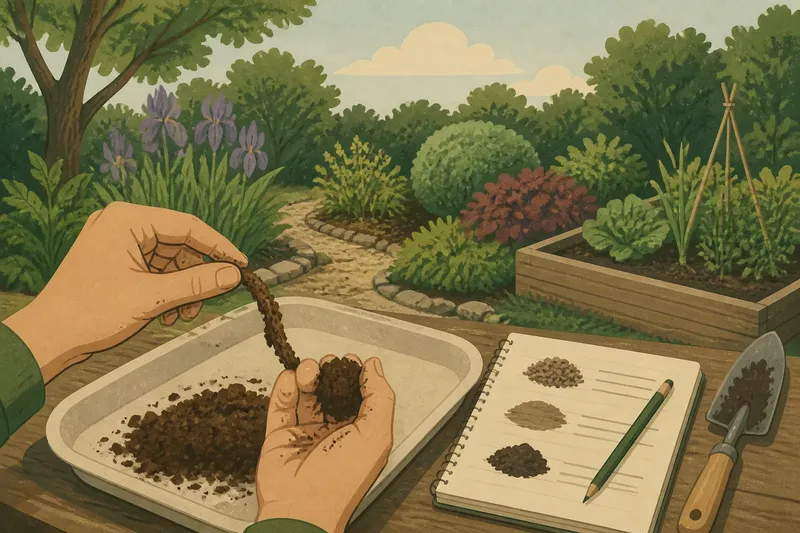
What can a garden soil texture test tell you before you choose plants or change a bed? A garden soil texture test gives a rough, useful reading of how sand, silt, and clay behave when a small soil sample is moist. It can suggest how quickly water may drain and how readily soil may hold together, but it cannot diagnose fertility, pH, compaction, or every cause of poor growth.
Start with a sound sample
Choose soil from the part of the garden you want to understand. A sunny border, a low spot, and a vegetable bed may have different textures, especially where soil has been moved or amended. One sample cannot stand in for an entire yard.
Take a small amount from below loose surface litter, but avoid an area beside a compost pile, path, or recent planting hole. Remove stones, roots, and obvious mulch. If the soil is dusty, add water a little at a time; if it is sticky with water, let it air briefly. Aim for a sample that feels damp and holds together, not one that drips or smears like paste.
Use your fingers and a clean dish or tray. The point is not to make a laboratory specimen. It is to compare the same handful for its graininess, smoothness, and ability to form a ball or ribbon.
Read the feel
Sand feels gritty, with grains you can notice between finger and thumb. A sandy sample usually falls apart readily when squeezed and is difficult to shape into a lasting ribbon. That suggests a larger share of coarse particles, though a few gritty grains do not make the whole soil sandy.
Silt feels smooth or floury when moist, with little of sand’s obvious grit and less of clay’s tackiness. It may form a weak ball, then break under gentle pressure. Dry silt can feel powdery; moist silt can be slippery, which is why a quick touch alone can be misleading.
Clay feels fine and sticky when damp. It can often be pressed into a thin ribbon between thumb and forefinger before it breaks. A longer, more coherent ribbon suggests more clay than a sample that crumbles quickly, but hand-feel does not give an exact proportion.
Most garden soil is a mixture. A sample may feel gritty at first and still make a short ribbon, or feel smooth while crumbling when squeezed. Record the combination rather than forcing it into a single category. Soil texture is about the relative amounts of sand, silt, and clay; “loam” describes a balanced mixture, not a separate particle.
Try the hand test
Take a pinch of prepared soil and add water until it can be pressed into a ball without leaving free water on your fingers. Squeeze gently, then rub the sample between your fingers. Notice whether grit stands out, whether the surface feels smooth, and whether the material sticks.
Next, press a portion between thumb and forefinger to form a ribbon. Let it extend under its own support until it breaks. Note whether it will not form, forms only a short crumbly strip, or makes a longer, cohesive ribbon. There is no need to pull hard; force can make almost any damp soil appear more workable than it is.
Say you are checking a bed where seedlings wilt after rain. Imagine the sample feels gritty, refuses to hold a ribbon, and falls apart as soon as you open your hand. That observation makes fast drainage plausible, so you might watch how quickly the bed dries and compare it with a nearby planting area. It does not establish that drainage is the cause; shallow roots, uneven watering, or a compacted layer could also be involved.
Write down the location, recent moisture, and what your fingers noticed. If you repeat the check in another part of the bed, use the same method and compare like with like. A small note can be more useful than a confident label.
What does the test answer?
Does gritty soil drain faster?
Coarse particles often leave larger spaces between them, so water may pass through sandy soil readily. Actual drainage also depends on layering, compaction, slope, organic matter, and how wet the ground already is.
Can a ribbon identify clay?
A sticky sample that forms a coherent ribbon is a useful clue that clay is present in a meaningful share. Ribbon length is only a rough comparison, not a laboratory measurement or a precise soil classification.
Can soil texture tell me what to plant?
It can help you shortlist plants that tolerate the bed’s likely moisture behavior. Match that clue with sunlight, seasonal wetness, local climate, and the plant’s stated growing needs rather than selecting from texture alone.
Does a hand test reveal soil pH?
No. Texture describes particle size, while pH describes acidity or alkalinity. Use an appropriate soil test if pH matters to a planting decision.
Keep its limits clear
Texture is not structure. Structure describes how particles gather into crumbs or aggregates and the spaces between them. A clay-rich soil can have a crumbly structure, while another clay-rich soil can be dense and difficult to work. The hand test may hint at feel and cohesion, but it does not show how roots encounter pore spaces through the bed.
Nor does texture measure organic matter, nutrients, salinity, or contamination. Dark color is not a dependable nutrient report, and a sample that feels soft is not proof that plants have everything they need. If plants repeatedly struggle despite suitable light and watering, a soil test through a local extension service or qualified soil laboratory can answer questions the fingers cannot.
Moisture changes the reading. Dry clay may form hard clods; very wet soil can smear and feel more adhesive than it does at workable moisture. A sample taken after heavy rain should not be compared casually with one gathered after a dry spell. If the result feels ambiguous, let a fresh sample reach a similar dampness and check again.
Recent additions matter, too. Compost, sand, leaf mold, or imported topsoil can create a patchwork in a bed. A handful from the planting hole may describe the amendment more than the surrounding ground. Think of the test like checking a fabric swatch: it tells you about the piece in your hand, not every layer beneath it.
Use the clue carefully
For plant choice, treat the result as one part of a site description. A bed that feels sandy may suit plants that prefer sharp drainage, but it may also dry quickly between rains. A clay-rich bed may retain moisture, yet remain too wet in a low spot. Observe the site after ordinary rain and during a dry spell; those conditions put the texture clue in context.
For soil improvement, avoid responding to a single tactile impression with a dramatic amendment. Adding a little of one material does not necessarily transform a whole bed, and mixing incompatible materials can create a poor working surface. Organic matter such as finished compost can support soil structure over time, but choose materials for the actual condition and use them in ways suited to the bed.
When a decision depends on a product label, manufacturer instructions, or local rules, follow those directions rather than the hand test. For ordinary plant selection, however, the test is a useful first observation: grit, smoothness, stickiness, and ribbon formation help you ask better questions about the place where roots will grow.
A garden soil texture test is most useful when it narrows uncertainty without pretending to erase it. Keep the sample tied to its location, compare similar moisture conditions, and pair touch with what you see after rain and watering. The next time a bed behaves oddly, that modest record can help distinguish a likely texture issue from a different problem worth checking.