From Knot Garden to Mixed Border: A Short History of Garden Beds
Garden bed history clarifies how knot gardens and mixed borders differ, helping you choose a form that suits your view, site, and tending habits.
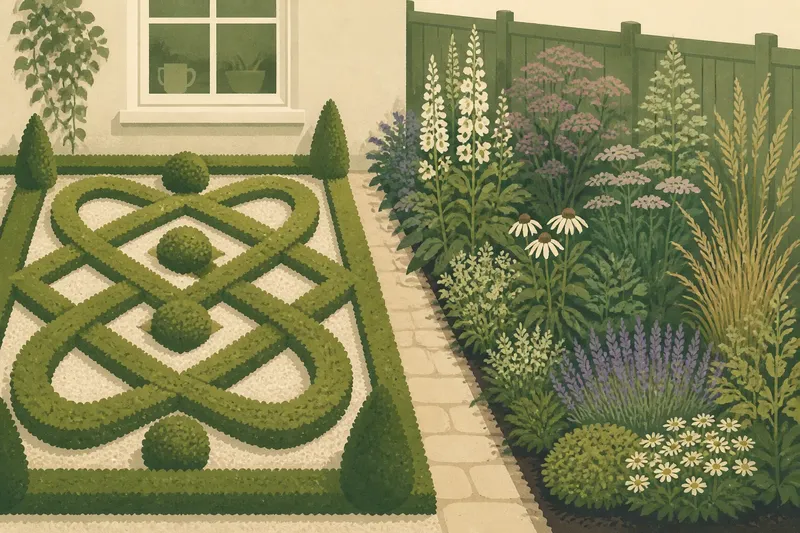
Should a garden bed read as a pattern from above or as a sequence of plants from a path? Garden bed history offers two useful forms to compare: the knot garden, with its deliberate geometry, and the mixed border, composed for views from the side. Their histories are not a simple handoff from one fashion to another; each reflects a different way of arranging and seeing plants.
Reading the knot garden
Knot gardens are associated with formal European gardens of the Renaissance period. Their interlaced patterns drew on the visual language of decorative knots, using low planting to mark lines that seemed to pass over and under one another. Garden writers and designs from the period helped circulate these patterns, though individual gardens varied in layout and materials.
Clipped herbs and other low plants could define the bands, with gravel, brick, or open ground separating them. The precise planting depended on the place and the gardener; there was no single recipe. The form is easiest to understand from an elevated window or terrace, where the pattern can be seen as a whole.
At ground level, a knot garden is encountered as clipped edges and narrow spaces rather than a complete motif. Its design depends on keeping planted lines distinct from the areas around them. A spreading shoot or uneven edge can make the intended pattern harder to read.
The mixed border takes shape
The mixed border developed as a planting form organized around combinations of plants rather than one low, continuous pattern. Its familiar arrangement is read from the side: lower plants near the front, taller growth behind, and variation in foliage, flowers, and seed heads across the seasons.
That account needs a qualification. Garden borders have changed over time, and the mixed border does not belong to one moment or one fixed style. Its central idea is practical as much as visual: plants are placed in relation to their neighbors and to the view, and the arrangement can be adjusted as the planting changes.
A border can still have a clear structure. Repeating a few plant forms or colors helps connect the composition, while differences in height and texture keep it from reading as a row. If every plant demands attention, the result can feel crowded; if taller growth blocks shorter plants, the layers lose their purpose.
Choose for the view
A knot garden suits a site where its pattern can be seen clearly and where you enjoy maintaining a defined outline. A mixed border fits a view along a path or from a window at standing height, especially when seasonal change is part of the design. Neither form dictates a specific plant list. Light, drainage, exposure, and soil should guide plant selection.
For a narrow bed, consider how much depth is available for front-to-back layers. A border viewed from both sides needs a different arrangement, often with taller plants nearer its center. A formal pattern can also sit within an irregular garden, but a clear internal outline helps prevent the bed’s outer edge from competing with it.
Say you have a rectangular bed outside a kitchen window, a narrow path along one side, and time for occasional rather than frequent trimming. You mark a small knot pattern with string, view it from the kitchen, and notice that the narrow lines are difficult to distinguish. You then mark a simpler front-to-back planting arrangement, with lower plants near the path and taller ones by the fence. If that second outline reads clearly from the window and leaves the path open, it is the better fit; the tradeoff is that the plants will need editing as they grow, rather than routine shaping of crisp lines.
Questions about garden beds?
Can a knot garden include flowers?
Yes, provided the plants stay low enough to preserve the pattern. Check how the foliage looks after flowering, since the bed’s structure remains visible when blooms fade.
Does a mixed border need a backdrop?
No, but a wall, fence, hedge, or taller planting can help make its layers easier to see. For a bed viewed from both sides, keep the edges lower and place taller growth toward the center.
Can both forms work in one garden?
Yes, if each has a clear place and purpose. A defined formal bed and a separate border along a path can coexist without forcing either to imitate the other.
Which form is easier to revise?
In a mixed border, individual plants can often be moved or replaced while the broader arrangement remains. Changing the lines of a knot garden may mean revising the pattern itself.
Keep the design clear
The short history is useful less as a sequence of styles than as a way to understand two distinct design decisions. Knot gardens make their structure through repeated lines; mixed borders use plant placement, height, and seasonal change. The distinction is as plain as choosing between a woven mat and a shelf of separate objects: both are arranged, but their parts hold together differently.
For garden bed history to be useful in your own space, begin with the actual viewing point. Mark a possible outline with a hose or string, look at it from the window or path, and check whether its shape remains clear. That small pause can prevent a design that works beautifully on paper but is difficult to read from the place you use most.